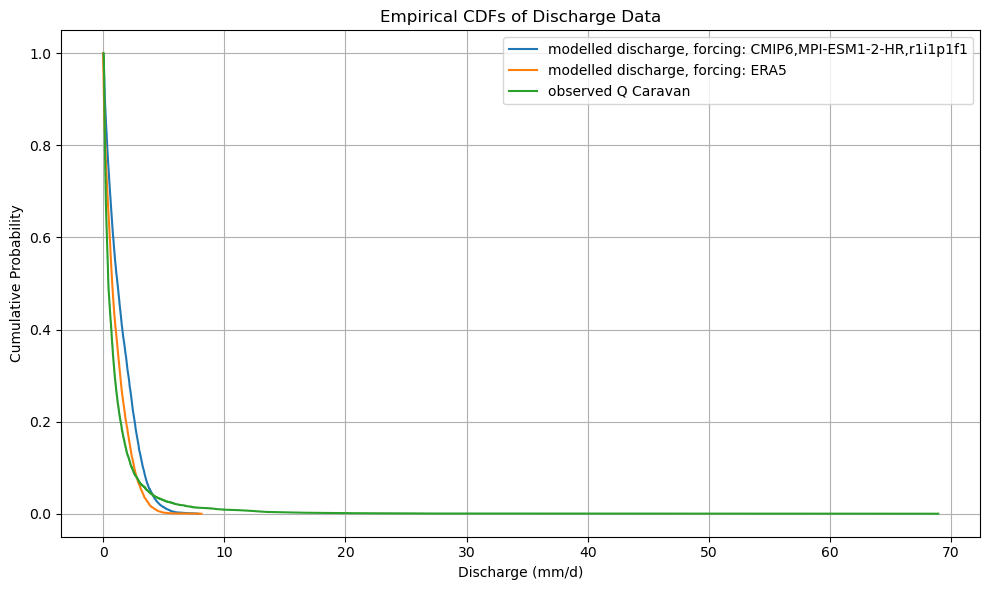
CDF comparison of ERA5 and CMIP model outputs#
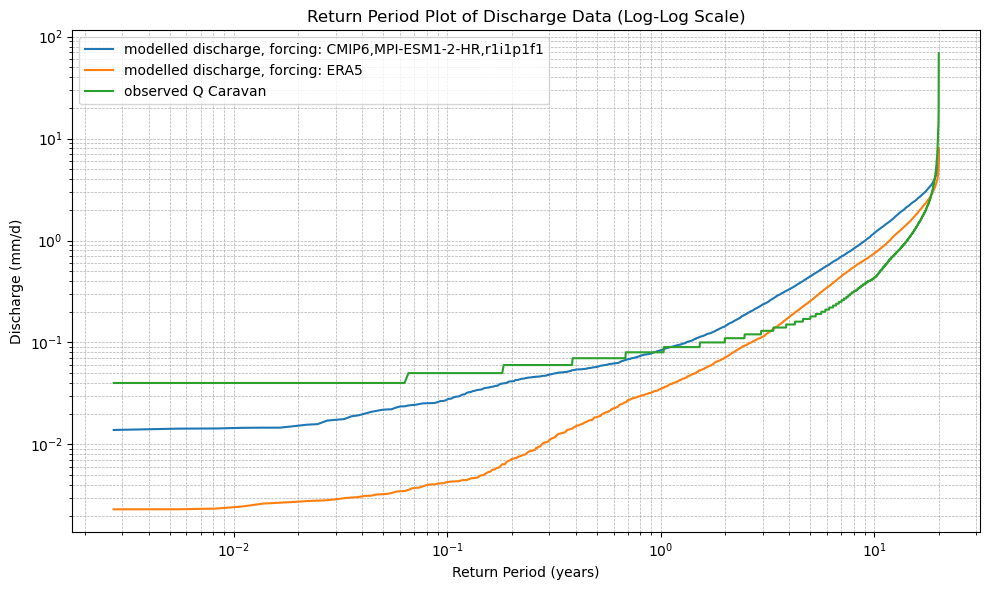
by sorting the output in order of decreasing discharge, we can easily make a cummalative distribution. By taking the difference of these functions we derive a (very simple) bias correction function that can later be used to bias-correct the future model output when forced with CMIP projections.
# General python
import warnings
warnings.filterwarnings("ignore", category=UserWarning)

import numpy as np
from pathlib import Path
import pandas as pd
import matplotlib.pyplot as plt
import xarray as xr
import json

# Niceties
from rich import print
# General eWaterCycle
import ewatercycle
import ewatercycle.forcing
# For MEV
from scipy.stats import genextreme, gumbel_r, weibull_min
# Parameters
region_id = None
settings_path = "settings.json"
# Parameters
region_id = "camelsgb_22007"
settings_path = "regions/camelsgb_22007/settings.json"
# Load settings
# Read from the JSON file
with open(settings_path, "r") as json_file:
    settings = json.load(json_file)
display(settings)
{'caravan_id': 'camelsgb_22007',
 'calibration_start_date': '1994-08-01T00:00:00Z',
 'calibration_end_date': '2004-07-31T00:00:00Z',
 'validation_start_date': '2004-08-01T00:00:00Z',
 'validation_end_date': '2014-07-31T00:00:00Z',
 'future_start_date': '2029-08-01T00:00:00Z',
 'future_end_date': '2049-08-31T00:00:00Z',
 'CMIP_info': {'dataset': ['MPI-ESM1-2-HR'],
  'ensembles': ['r1i1p1f1'],
  'experiments': ['historical', 'ssp126', 'ssp245', 'ssp370', 'ssp585'],
  'project': 'CMIP6',
  'frequency': 'day',
  'grid': 'gn',
  'variables': ['pr', 'tas', 'rsds']},
 'base_path': '/gpfs/scratch1/shared/mmelotto/ewatercycleClimateImpact/HBV',
 'path_caravan': '/gpfs/scratch1/shared/mmelotto/ewatercycleClimateImpact/HBV/forcing_data/camelsgb_22007/caravan',
 'path_ERA5': '/gpfs/scratch1/shared/mmelotto/ewatercycleClimateImpact/HBV/forcing_data/camelsgb_22007/ERA5',
 'path_CMIP6': '/gpfs/scratch1/shared/mmelotto/ewatercycleClimateImpact/HBV/forcing_data/camelsgb_22007/CMIP6',
 'path_output': '/gpfs/scratch1/shared/mmelotto/ewatercycleClimateImpact/HBV/output_data/camelsgb_22007',
 'path_shape': '/gpfs/scratch1/shared/mmelotto/ewatercycleClimateImpact/HBV/forcing_data/camelsgb_22007/caravan/camelsgb_22007.shp',
 'downloads': '/gpfs/scratch1/shared/mmelotto/ewatercycleClimateImpact/HBV/downloads/camelsgb_22007'}
# Open the output of the historic model and CMIP runs
xr_historic = xr.open_dataset(Path(settings['path_output']) / (settings['caravan_id'] + '_historic_output.nc'))
print(xr_historic)
<xarray.Dataset> Size: 205kB
Dimensions:                                                    (time: 7305)
Coordinates:
  * time                                                       (time) datetime64[ns] 58kB ...
Data variables:
    modelled discharge, forcing: CMIP6,MPI-ESM1-2-HR,r1i1p1f1  (time) float64 58kB ...
    modelled discharge, forcing: ERA5                          (time) float64 58kB ...
    observed Q Caravan                                         (time) float32 29kB ...
Attributes:
    units:    mm/d
def plot_hydrograph(data_array):
    plt.figure()
    for name, da in data_array.data_vars.items():
        data_array[name].plot(label = name)
    plt.ylabel("Discharge (mm/d)")
    plt.legend()


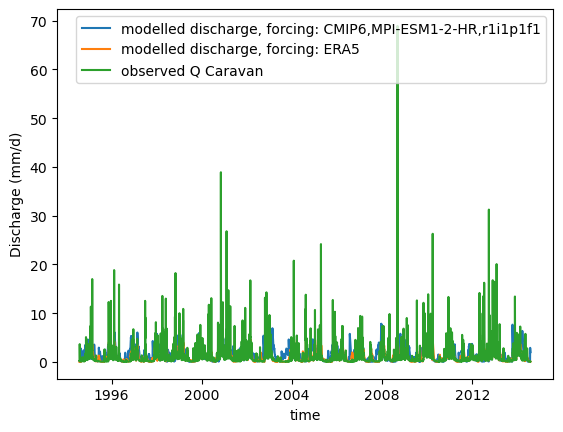
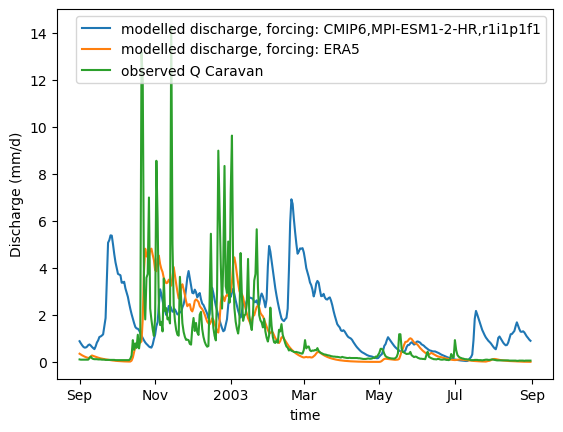
xr_one_year = xr_historic.sel(time=slice('2002-09-01', '2003-08-31'))

plot_hydrograph(xr_historic)
plot_hydrograph(xr_one_year)
def plot_cdf(ds):
    """
    plot cdf for all data variables

    Parameters:
    - ds: xarray.Dataset
                       defaults to True
    Returns:
    - nothing
    """
    # 1. Drop time points with missing data in any variable
    valid_ds = ds.dropna(dim="time")

    # 2. Sort each variable from highest to lowest
    sorted_vars = {
        name: np.sort(valid_ds[name].values)[::-1]  # sort descending
        for name in valid_ds.data_vars
    }

    # 3. Create new indices
    n = len(valid_ds.time)
    cdf_index = np.linspace(0, 1, n)
    return_period_days = np.linspace(n, 1, n)
    return_period_years = return_period_days / 365.25  # convert to years

    # 4. Construct new xarray Dataset for CDFs
    cdf_ds = xr.Dataset(
        {
            name: ("cdf", sorted_vars[name])
            for name in sorted_vars
        },
        coords={
            "cdf": cdf_index,
            "return_period": ("cdf", return_period_years)
        }
    )

    # 5. Plot the CDFs
    plt.figure(figsize=(10, 6))
    for name in cdf_ds.data_vars:
        plt.plot(cdf_ds[name], cdf_ds.cdf, label=name)

    plt.ylabel("Cumulative Probability")
    plt.xlabel("Discharge (mm/d)")
    plt.title("Empirical CDFs of Discharge Data")
    plt.legend()
    plt.grid(True)
    plt.tight_layout()
    plt.show()

    # 6. Plot the Return Period curves (log-log scale)
    plt.figure(figsize=(10, 6))
    for name in cdf_ds.data_vars:
        plt.plot(cdf_ds.return_period, cdf_ds[name], label=name)

    plt.xscale("log")
    plt.yscale("log")
    plt.xlabel("Return Period (years)")
    plt.ylabel("Discharge (mm/d)")
    plt.title("Return Period Plot of Discharge Data (Log-Log Scale)")
    plt.legend()
    plt.grid(True, which="both", linestyle="--", linewidth=0.5)
    plt.tight_layout()
    plt.show()
plot_cdf(xr_historic)
def calculate_mev(ds, dist_type='gev'):
    """
    Calculate MEV-based return periods for all data variables in an xarray.Dataset.

    Parameters:
    - ds: xarray.Dataset
    - dist_type: str, one of ['gev', 'gumbel', 'weibull']

    Returns:
    - xarray.Dataset with MEV return periods
    """
    # Step 1: Drop time points with missing data in any variable
    valid_ds = ds.dropna(dim="time", how="any")

    # Step 2: Extract daily values for each year
    years = np.unique(valid_ds['time.year'].values)
    mev_distributions = {}

    for var in ds.data_vars:
        annual_params = []
        for year in years:
            values = valid_ds[var].sel(time=str(year)).values
            if len(values) > 0:
                # Fit distribution based on dist_type
                if dist_type == 'gev':
                    params = genextreme.fit(values)
                    dist_func = genextreme
                elif dist_type == 'gumbel':
                    params = gumbel_r.fit(values)
                    dist_func = gumbel_r
                elif dist_type == 'weibull':
                    params = weibull_min.fit(values)
                    dist_func = weibull_min
                else:
                    raise ValueError("dist_type must be one of ['gev', 'gumbel', 'weibull']")
                annual_params.append(params)

        # Generate MEV by averaging annual distributions
        x_vals = np.linspace(np.min(valid_ds[var]), np.max(valid_ds[var]), 1000)
        cdfs = [dist_func.cdf(x_vals, *params) for params in annual_params]
        mean_cdf = np.mean(cdfs, axis=0)
        return_period = 1 / (1 - mean_cdf)

        mev_distributions[var] = (x_vals, return_period)

    # Step 3: Create MEV xarray Dataset
    mev_ds = xr.Dataset(
        {
            var: ("x", mev_distributions[var][1])
            for var in mev_distributions
        },
        coords={
            "x": list(mev_distributions.values())[0][0],
        },
        attrs=ds.attrs  # retain metadata
    )

    return mev_ds

def plot_mev(*mev_datasets, dist_type='gev', labels=None):
    """
    Plot MEV curves from one or more xarray.Dataset objects created by calculate_mev().

    Parameters:
    - mev_datasets: one or more xarray.Dataset objects
    - dist_type: str, name of the distribution used (for plot title)
    - labels: list of str, labels for each dataset
    """
    plt.figure(figsize=(10, 6))

    for i, mev_ds in enumerate(mev_datasets):
        prefix = f"{labels[i]} - " if labels else ""
        for var in mev_ds.data_vars:
            plt.plot(mev_ds[var].values, mev_ds['x'].values, label=f"{prefix}{var}")

    plt.xscale("log")
    plt.yscale("log")
    plt.xlabel("Return Period (years)")
    plt.ylabel("Discharge (mm/d)")
    plt.title(f"Metastatistical Extreme Value (MEV) Estimates - {dist_type.upper()} Fit")
    plt.legend()
    plt.grid(True, which="both", linestyle="--", linewidth=0.5)
    plt.tight_layout()
    plt.show()
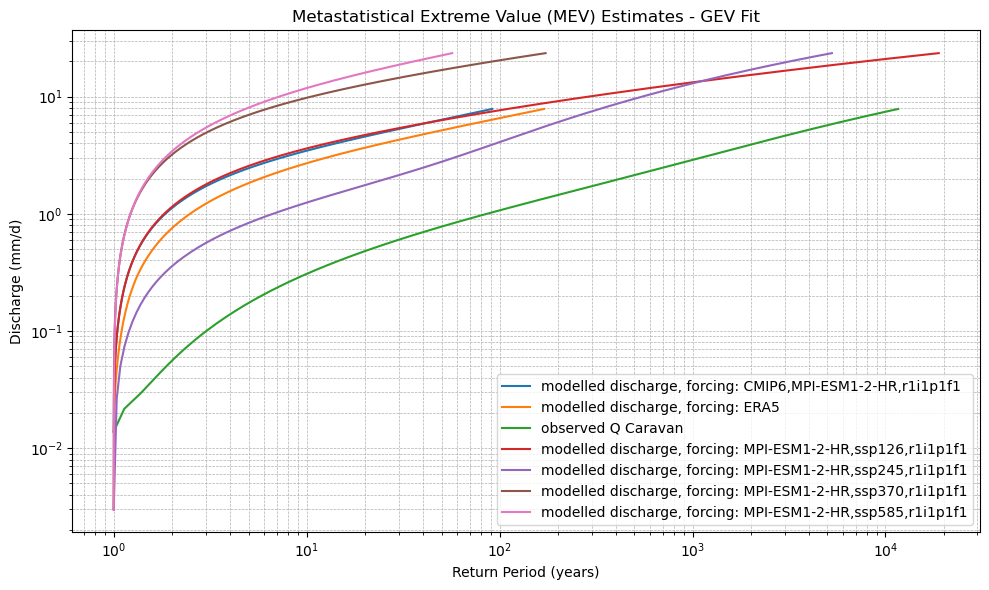
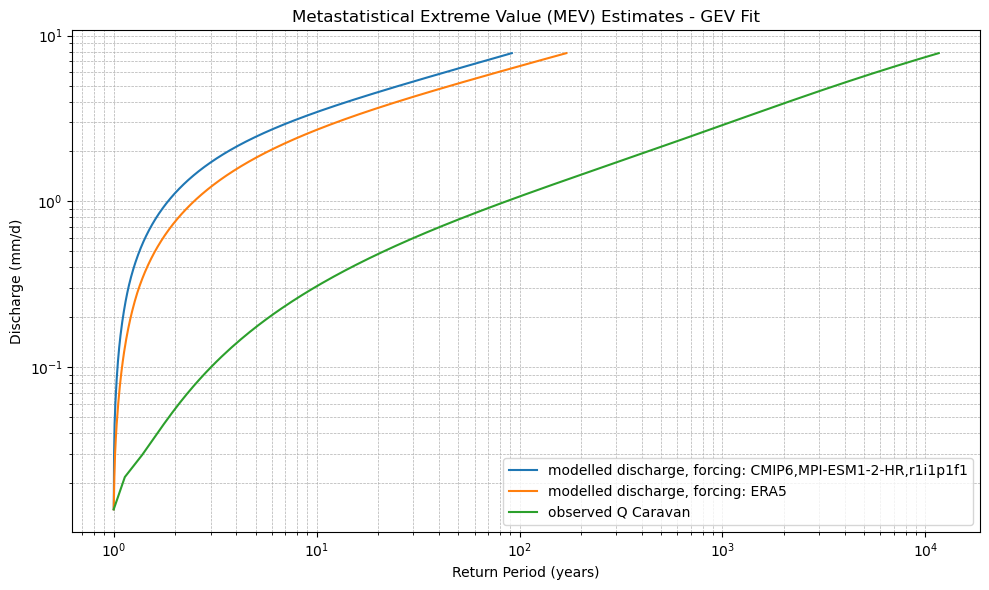
xr_mev_historic = calculate_mev(xr_historic,'weibull')
plot_mev(xr_mev_historic)
# Open the output of the historic model and CMIP runs
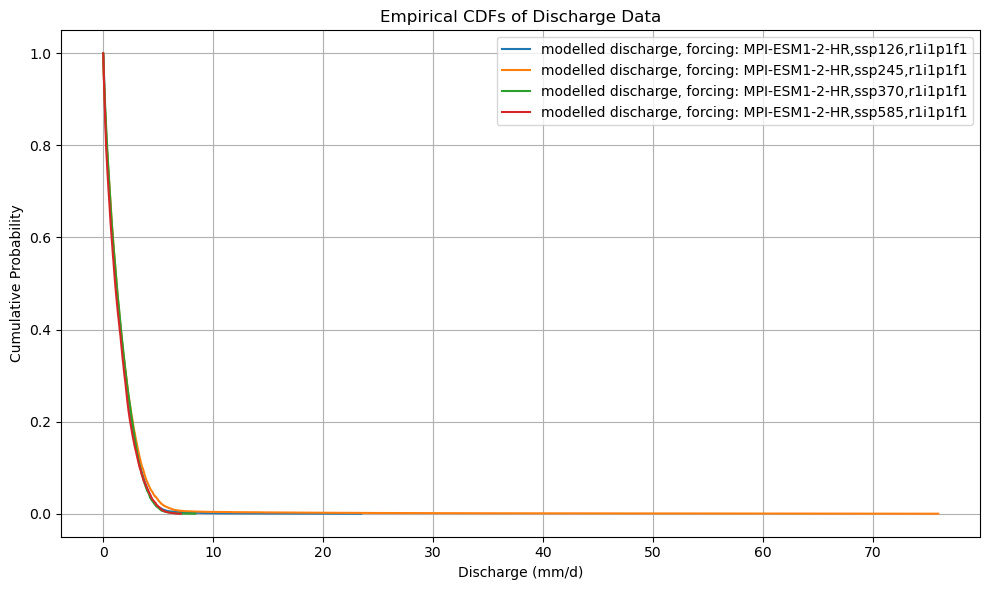
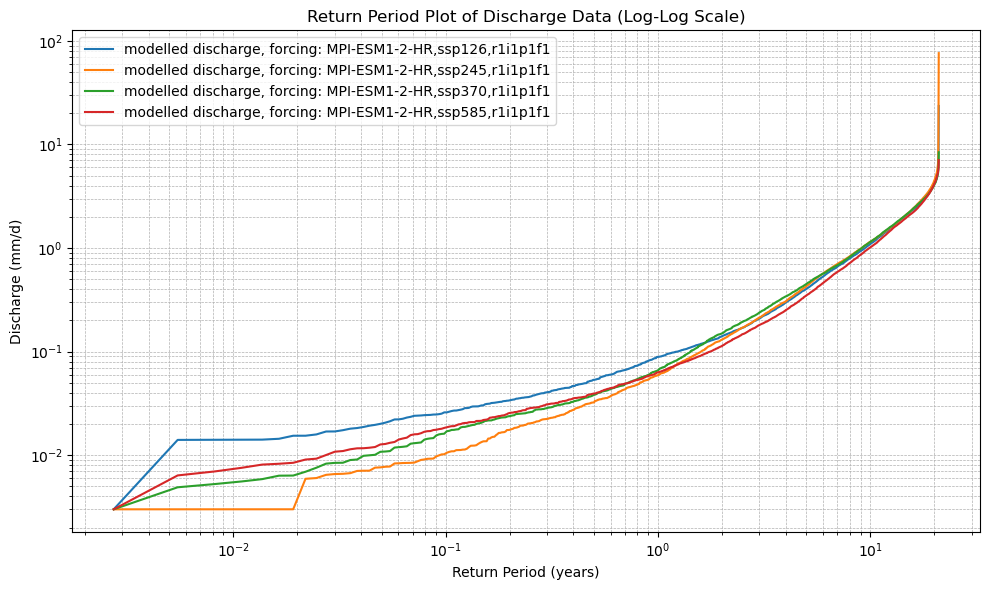
xr_future = xr.open_dataset(Path(settings['path_output']) / (settings['caravan_id'] + '_future_output.nc'))
plot_cdf(xr_future)
xr_mev_future = calculate_mev(xr_future,'weibull')
plot_mev(xr_mev_future)
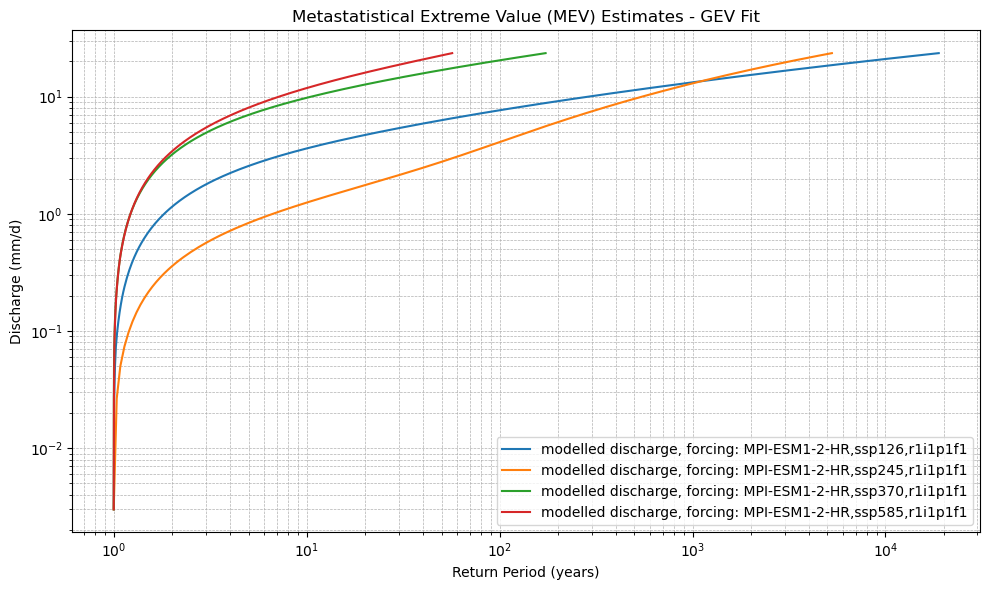
plot_mev(xr_mev_historic, xr_mev_future)